
Moisture guide · Solar Whiz & SolarVenti
Subfloor ventilation: drying out the space under your floor
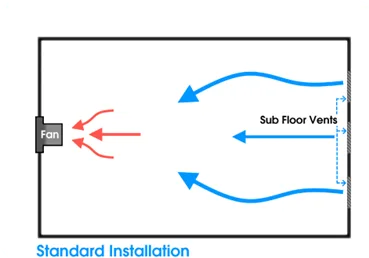
Damp under a suspended floor doesn't stay under the floor. It moves up through floorboards as vapour, carries the musty smell with it, and feeds mould in rooms that look perfectly dry. Cross-flow ventilation — drawing air in one side and pushing it out the other — is what actually shifts it.
How it works
The Solar Whiz roof ventilators and exhaust fan prevent heat build-up in your roof cavity or attic space and reduce the heat load on your ceiling. This prevents heat from radiating down into your living space. This results in lower roof space temperatures as well as lower internal temperatures. Replacement air is the key to the Solar Whiz functionality and must be available for the unit to effectively remove heat or moisture. Replacement air is most commonly accessed via eave vents or ceiling vents. Heat or moisture may also be extracted directly via ducting. Three configurations are described: (1) standard roof ventilation installation with eave vents, (2) heat removal from the interior via ceiling vents, (3) direct heat extraction and removal via ducts.
Source: Solar Whiz ↗
The SolarVenti solar collector can be placed on the roof or on the wall. The air inside the solar collector is heated by the sun which also generates electricity for the ventilator. Fresh air is taken in by small holes on the backside of the panels and the warm air is blown into the house. The dry warm air is spread all over in the house. The system creates slight excess pressure in the house, which constantly pushes the old air out through gaps and air escape vents.
Source: SolarVenti ↗
Pros
- Runs entirely on solar with no running costs and no electricity bills; suitable for sheds where there is no electricity available. Solar Whiz ↗
- Australian made - designed, built and tested at a factory in Melbourne, Victoria. Solar Whiz ↗
- Stainless steel construction with an aluminium fan cap, described as extremely durable and lightweight; competitors are said to use mild powder-coated steel or plastic. Solar Whiz ↗
- SS316 units available for coastal or other corrosive environments. Solar Whiz ↗
- Bushfire-rated units available, designed to comply with regulations for buildings in bushfire-prone areas. Solar Whiz ↗
- DIY-friendly and can usually be installed by any competent handyman with the right tools. No electrician required for the base unit. Solar Whiz ↗
- Safe low voltage installation; tiltable solar panel to optimise the angle to the sun. Solar Whiz ↗
- Can be installed on any type of roof including tile, zincalume and colorbond. Solar Whiz ↗
- Thermostat, hygrostat and night operation accessories available for control over when the unit runs. Solar Whiz ↗
- Airflow figures are stated as RAF (Real Air Flow), tested with all components attached, rather than theoretical capacity. Solar Whiz ↗
- Free to run and not connected to the main electricity supply - zero daily cost outgoings. SolarVenti ↗
- Maintenance-free. Rain washes dust, pollen and other impurities off the system. The panel filter is maintenance free. SolarVenti ↗
- Frame and back plates are salt-resistant aluminium; the collector is described as immune to corrosion even in an aggressive environment. All screws and rivets are stainless steel and salt-resistant aluminium. SolarVenti ↗
- Glazing is UV-resistant Lexan rather than glass - shockproof, does not splinter, lighter than glass and easy to replace. SolarVenti ↗
- DIY installable by anyone competent with ordinary trade tools; delivered as a do-it-yourself pack with all accessories. SolarVenti ↗
- Can be mounted vertically or horizontally, on wall or roof, with roof kits available after purchase. All models delivered with wall brackets. SolarVenti ↗
- 5 year factory warranty on all solar air collectors. SolarVenti ↗
- Tested and approved by Delta Centre of Test Excellence, KeyMark Certification, DANETV and Fraunhofer. SolarVenti ↗
- Low noise - approx 40 dB at full capacity, adjustable down via the regulator. SolarVenti ↗
Cons and limits
Stated by the manufacturers themselves. Worth reading before you buy — most ventilation disappointments come from one of these.
- Replacement air must be available for the unit to work; without eave vents or other air intake a roof ventilator will struggle to extract air - it would be trying to pull air out of a vacuum. Solar Whiz ↗
- Galvanised eave vents are not suitable for installation in coastal or other highly corrosive environments; replacement air must be sourced elsewhere. Solar Whiz ↗
- Low-light conditions reduce the capacity at which the unit can ventilate. Full capacity in low light or at night requires the extra-cost Night Operations Kit. Solar Whiz ↗
- Runs whenever there is active sunlight, including in winter, unless a thermostat is fitted to stop it. Solar Whiz ↗
- Roofs too steep for conventional roof mounting require gable/wall-mounted units instead. Solar Whiz ↗
- Cathedral-style roofing requires extension collars so the unit does not protrude into the ceiling space. Solar Whiz ↗
- Flat or lower pitch roofing needs more eave vents to maximise air replacement and evenly distribute airflow. Solar Whiz ↗
- Subfloor: requires 500mm+ clearance to fit the Solar Whiz wall-mounted fan, otherwise an inline fan must be used instead. Solar Whiz ↗
- Commercial unit is rated at <73dBA, notably louder than the residential units. Solar Whiz ↗
- Components warranty is 2 years; only the PV panels carry the 10-year term. Solar Whiz ↗
- The SolarVenti itself does not dehumidify. It has a dehumidifying effect only because it sends dry, warm air into the building when the outside air is at its driest and cleanest. This is a materially different mechanism to a compressor dehumidifier. SolarVenti ↗
- Only runs when the sun is shining. During very cloudy periods nothing will happen. There is no mains backup option described. SolarVenti ↗
- The fan requires a certain voltage from the solar cell before it can start up. In weak sun you may hear a low buzzing noise from the fan trying to start, and some users report needing to nudge the fan. SolarVenti ↗
- Visible condensation forms on the inside of the Lexan layer at regular intervals, most commonly after an idle period. Stated as normal and harmless, but it is visible. SolarVenti ↗
- The panel must face as close to due north as possible with as little shade as possible from trees or other buildings. SolarVenti ↗
- Roof-mounted panels must be tilted to 60 degrees to catch the winter sun. The pitch is also needed so the panel can release heat when switched off. SolarVenti ↗
- Shading constraint: an SV7 mounted high on a wall under a large overhang will probably remain switched off most of the time, because its solar cell sits in the middle of the panel. SolarVenti ↗
- SolarVenti cannot guarantee the system will keep a house frost-free. SolarVenti ↗
- Air output in the first year runs higher and cooler than the brochure figures, because the solar cell over-produces before stabilising after approximately one year. SolarVenti ↗
- Ducting run is capped per model - 1-2m for SV3, 1-4m for SV7 and SV14, 1-5m for SV20, 1-15m for SV30. Shorter pipes give better utilisation of heat. SolarVenti ↗
- Poorly placed intakes can draw in neighbouring chimney smoke or other outdoor pollution; the system should not be installed close to the ground. SolarVenti ↗
- SV30 installation on a roof requires two people (panel weighs 28 kilos) and takes around 7 hours. SolarVenti ↗
What you'll need
- Adequate replacement air - eave vents, ceiling vents, or existing passive vents. Commercial sites without vents can use partly open windows, roller doors or emergency exit doors while the units run. Solar Whiz ↗
- Roof pitch assessment: steep roofs need gable fans, cathedral ceilings need extension collars, flat/low pitch needs additional eave vents. Solar Whiz ↗
- For Night Operations Kit: a 24-volt power supply connected to a power point in the roof space, installed with the help of an electrician. Solar Whiz ↗
- Subfloor: 500mm+ clearance for a wall/gable mounted fan; otherwise a 25 Watt 320mm diameter inline fan is used. Solar Whiz ↗
- Purchase is via the GES dealer network across Australia, or direct from GES. Solar Whiz ↗
- Commercial sizing requires the facility volume (length x width x height) multiplied by the recommended air changes per hour for the building type. Solar Whiz ↗
- A north-facing wall or roof area with minimal shade from trees or other buildings. SolarVenti ↗
- For roof mounting: the panel tilted to 60 degrees, plus the correct roof kit for the roof type - Type1 fibre cement, Type2 steel/roofing felt/bitumen/Decra, Type3 tile with roof anchors. Roof kits are a separate purchase. SolarVenti ↗
- An air escape vent, ideally at the opposite end of the house to the injection air duct, so the warm dry air distributes through the whole house. SolarVenti ↗
- Insulated ducting - twin lined or lagged, preferably R1 rating or greater for long runs from roof to ceiling or lower ground rooms. Ducting must be outstretched, vertical runs supported, and not reduced or squeezed anywhere on the run. SolarVenti ↗
- Panel sized to the room area to be ventilated: SV3 up to 25m2, SV7 up to 50m2, SV14 up to 80m2, SV20 up to 100m2, SV30 up to 150m2. Houses over about 90 sq m with a long floor plan may need a larger panel or two units, one at each end. SolarVenti ↗
- Two people for SV30 roof installation; installation time ranges from about 2 hours (SV3 wall) to 7 hours (SV20/SV30), roughly double for roof-mounted versions. SolarVenti ↗
- For active cooling, an extra fan and a room thermostat which switches between the fans are required - this is an extension beyond the base system. SolarVenti ↗
Expected results
Every figure below is a manufacturer claim, reproduced as published and linked to its source. Airdry has not independently tested these. Actual results vary with roof area, orientation, insulation, climate zone and available replacement air.
| Claim | Figure | Source |
|---|---|---|
| SV14 air delivery and temperature rise | approx. 60 - 110 m3 air per hour with approx. 25-30 degrees C temperature rise compared to air temperature outdoors | SolarVenti ↗ |
| SV20 air delivery and temperature rise | ca. 80-140 m3 in blown air per hour up to 30K at full solar radiation | SolarVenti ↗ |
| SV30 air delivery and temperature rise | ca. 150 m3 in blown air per hour up to 40K at full solar radiation | SolarVenti ↗ |
| Noise level | approx. 40 db (plus/minus 2 db, depending on solar radiation) at full capacity | SolarVenti ↗ |
| Solar cell life expectancy | 10 - 20 years | SolarVenti ↗ |
| Fan life | a Sunon with double-row ball bearings and, in theory, 30,000 hours of operation which corresponds to approx. 25 years of wear and tear | SolarVenti ↗ |
| Thermal comfort factors | SolarVenti air collectors provide a positive impact on 4/6 factors for good thermal comfort (Airah/ASHRAE): Air Temperature, Radiant Heat Temperature, Air Movement, Humidity | SolarVenti ↗ |
| Track record | SolarVenti has sold solar air collectors since 1986; homepage also states 'Trusted for over 20 Years' | SolarVenti ↗ |
| SAM customer testimonial (via Solar Whiz site, related product) | 'the ambient temperature in the house reaches 20C... we have reduced our reliance on fossil fuel heating sources between 60% to 80%, depending on the weather conditions' - customer statement, not a manufacturer measurement | SolarVenti ↗ |
Published specifications
| Model | Airflow | Power | Noise | Coverage | Warranty | |
|---|---|---|---|---|---|---|
| SW-AU-W-28Wall/gable mounted solar fan (also used for sub floor ventilation) | 2000 m³/h | Solar, 28W PV | not published | — | — | ↗ |
| SW-AU-W-40Wall/gable mounted solar fan (also used for sub floor ventilation) | 2500 m³/h | Solar, 40W PV | not published | — | — | ↗ |
| SUB1200330mm inline fan with 300mm adaptor (no PV) | 1200 m³/h | Mains / optional | not published | — | — | ↗ |
| SUB0700220mm subfloor fan with louvre vent | 700 m³/h | Solar, 10W PV | not published | — | — | ↗ |
Frequently asked questions
Why do you need subfloor ventilation fans?
Noticing a musty smell around your home or signs of damp beneath your floors? Poor subfloor ventilation might be the cause. Moisture and stagnant air in these areas can lead to mould, timber rot, and even attract pests. Subfloor ventilation fans offer a practical solution, helping circulate fresh air, reduce humidity, and keep the space under your home dry and healthy. If there isn't enough space to install a Solar Whiz subfloor ventilation fan, inline fans offer a great alternative for underfloor ventilation.
Source: Solar Whiz ↗
How does the SolarVenti work from a technical point of view?
The system is free to run and is not connected to the main electricity supply. It is supplied with electricity via a solar cell. When the sun shines it warms up the air in the absorber and the integrated solar cell produces electricity for the built-in fan which blows the heated air into the house. Fresh air from outside is sucked / pulled in through a perforated back plate and a 2 mm black layer of felt. The air velocity is so low that only extremely small amounts of dust, pollen etc. are drawn into the system. This dust will eventually dissipate through use. When the system is running, air flow remains inside the panel. When the system is switched off, it cools itself down - even if there is bright sunshine. The heat rises inside the solar panel and exits via the felt and the back plate (open construction).
Source: SolarVenti ↗
Why is there visible condensation on the inside of the top Lexan plastic layer of my SolarVenti solar air collector?
Once the SolarVenti has been installed, there will be visible condensation on the Lexan plastic finishing coat on the inside of the solar air collector at regular intervals. This is quite normal and will in no way damage the system. When the warm air in the solar panel meets the cold air - or at any rate colder air - outside the panel, the condensation will become visible. Therefore, condensation will be most common when the solar air collector starts up after an idle period due to cloudy weather. You can avoid the visible condensation by switching off the solar air collector for an hour or two depending on the weather conditions.
Source: SolarVenti ↗
Is maintenance of a SolarVenti system necessary?
No, it is maintenance-free. Rain and snow wash dust, pollen and other impurities off the system.
Source: SolarVenti ↗
Can dust get into the house or into the system?
No, the air is filtered through the felt. The felt cannot get clogged as the air is drawn into the absorber through the whole of the rear of the panel.
Source: SolarVenti ↗
How does the system dehumidify? Other dehumidification systems have compressors. This one doesn't.
It is true that the SolarVenti itself does not dehumidify. The system has a dehumidifying effect due to the fact that it sends dry, warm air into the building at times when the air outside is at its driest and cleanest, i.e. when the weather is relatively clear. The best weather for dehumidification is actually a cold clear winter's day, even with a little snow on the ground. The air is particularly dry and clean and the reflection from the snow gives the system an extra boost.
Source: SolarVenti ↗
What are the exterior SolarVenti panels made of?
The frame and the back plates are made of salt-resistant aluminum. This makes the SolarVenti easy to lift, move and install. Due to its construction, the solar air collector is immune to corrosion - even in an aggressive environment. The glass plate is not glass but UV-resistant Lexan (plastic) which has insulating properties and does not splinter if the SolarVenti is dropped during transport for example. The Lexan plate is shockproof and will not even break if you kick a football at it. It is also very easy to replace. All screws and rivets are made from stainless steel and salt-resistant aluminum.
Source: SolarVenti ↗
What is the life expectancy for a SolarVenti?
Based on the experience of Danish customers with the early version of the holiday house pack, in which the solar cell was positioned next to the panel, we expect the life expectancy for the solar cell to be 10 - 20 years. This is the most critical component in the panel. The fan is one of the best and quietest on the market - a Sunon with double-row ball bearings and, in theory, 30,000 hours of operation which corresponds to approx. 25 years of wear and tear.
Source: SolarVenti ↗
Why is the solar cell built into the panel?
It makes it easier to position the system on the wall or roof, and it looks nicer. The solar cell is more protected from hail, branches, footballs, wind and other types of weather when it is built into the panel.
Source: SolarVenti ↗
How much noise does a SolarVenti make?
When it is running at full capacity, the acoustic pressure is approx. 40 db (plus/minus 2 db, depending on solar radiation). This corresponds to the noise from a very quiet extractor fan and we have not yet had any customers who have been bothered by the noise from the SolarVenti. Moreover, the noise level (air flow) can be adjusted using the fan's regulator. When the fan is turned down the temperature of the injection air should rise.
Source: SolarVenti ↗
What is the difference between a regulator and an on/off switch?
The regulator can reduce the speed of the ventilator (air) and, thus, increase the heat of the air while reducing the noise level. The regulator can also be switched off if you turn it to zero. The on/off switch only has an ON/OFF function.
Source: SolarVenti ↗
What is the optimal position for the system?
The system should face as close to due North as possible and have as little shade, from trees or other buildings, as possible.
Source: SolarVenti ↗
Is it best to mount the system on a wall or a roof?
In theory, it is best to mount the system on a roof because the sun goes down at an angle on the west to the horizon. If you mount the panel on the roof, it must be tilted to 60 degrees in order to catch the winter sun. The pitch also ensures that dirt does not collect on the surface of the panel and snow does not lie on the light-permeable surface. Lastly, the pitch is required to ensure that the solar air collector panel can release heat when the system is switched off, e.g. on a warm summer day.
Source: SolarVenti ↗
Does the panel have a right way up?
The solar air collector panel can be mounted vertically, like a door, or horizontally. The position is solely determined by what looks nicest and the limitations of the building itself.
Source: SolarVenti ↗
Can the system keep the house frost-free?
At our latitude, temperatures must be extreme before the system is not able to keep the house frost-free. However, we cannot guarantee that the system will keep the house frost-free. There is also a great difference in the way in which houses are insulated and there are other crucial factors. For example, the way in which the air circulates differs from house to house. It is also of significant importance that the system has the right dimensions and is positioned correctly. The system must also have enough time/sun to ensure thorough dehumidification.
Source: SolarVenti ↗
In stock at Airdry
Subfloor ventilation products

Sources and citations
Every technical claim on this page comes from the manufacturer's own published material, extracted 2026-08-12. Airdry (Solair Pty Ltd) is an official Australian distributor for these brands. Where the manufacturer's figures conflict across their own pages, we've said so above rather than choosing one silently.
- https://www.solarwhiz.com.au/
- https://solarventi.com.au/
- https://www.solarwhiz.com.au/home-ventilation/products/
- https://www.solarwhiz.com.au/news-information/residential-faqs/
- https://solarventi.com.au/about/how-the-solarventi-works/frequently-asked-questions/
- https://solarventi.com.au/test-reports/
- https://www.solarwhiz.com.au/sub-floor-ventilation-fans/
- https://www.solarwhiz.com.au/news-information/commercial-faqs/
- https://solarventi.com.au/product-category/solar-air-collectors/
No pricing is published by any manufacturer; all prices on this site are Airdry's own and include GST.