
Commercial guide · Solar Whiz
Solar powered ventilation for warehouses and commercial buildings
Large roof areas trap enormous volumes of hot air, and mains-powered extraction runs hardest exactly when electricity costs most. Solar-driven units scale to 10,000 m³/h and draw nothing from the grid — but a commercial site needs a deliberate intake-air strategy, not just extraction.
How it works
The Solar Whiz roof ventilators and exhaust fan prevent heat build-up in your roof cavity or attic space and reduce the heat load on your ceiling. This prevents heat from radiating down into your living space. This results in lower roof space temperatures as well as lower internal temperatures. Replacement air is the key to the Solar Whiz functionality and must be available for the unit to effectively remove heat or moisture. Replacement air is most commonly accessed via eave vents or ceiling vents. Heat or moisture may also be extracted directly via ducting. Three configurations are described: (1) standard roof ventilation installation with eave vents, (2) heat removal from the interior via ceiling vents, (3) direct heat extraction and removal via ducts.
Source: Solar Whiz ↗
Pros
- Runs entirely on solar with no running costs and no electricity bills; suitable for sheds where there is no electricity available. Solar Whiz ↗
- Australian made - designed, built and tested at a factory in Melbourne, Victoria. Solar Whiz ↗
- Stainless steel construction with an aluminium fan cap, described as extremely durable and lightweight; competitors are said to use mild powder-coated steel or plastic. Solar Whiz ↗
- SS316 units available for coastal or other corrosive environments. Solar Whiz ↗
- Bushfire-rated units available, designed to comply with regulations for buildings in bushfire-prone areas. Solar Whiz ↗
- DIY-friendly and can usually be installed by any competent handyman with the right tools. No electrician required for the base unit. Solar Whiz ↗
- Safe low voltage installation; tiltable solar panel to optimise the angle to the sun. Solar Whiz ↗
- Can be installed on any type of roof including tile, zincalume and colorbond. Solar Whiz ↗
- Thermostat, hygrostat and night operation accessories available for control over when the unit runs. Solar Whiz ↗
- Airflow figures are stated as RAF (Real Air Flow), tested with all components attached, rather than theoretical capacity. Solar Whiz ↗
Cons and limits
Stated by the manufacturers themselves. Worth reading before you buy — most ventilation disappointments come from one of these.
- Replacement air must be available for the unit to work; without eave vents or other air intake a roof ventilator will struggle to extract air - it would be trying to pull air out of a vacuum. Solar Whiz ↗
- Galvanised eave vents are not suitable for installation in coastal or other highly corrosive environments; replacement air must be sourced elsewhere. Solar Whiz ↗
- Low-light conditions reduce the capacity at which the unit can ventilate. Full capacity in low light or at night requires the extra-cost Night Operations Kit. Solar Whiz ↗
- Runs whenever there is active sunlight, including in winter, unless a thermostat is fitted to stop it. Solar Whiz ↗
- Roofs too steep for conventional roof mounting require gable/wall-mounted units instead. Solar Whiz ↗
- Cathedral-style roofing requires extension collars so the unit does not protrude into the ceiling space. Solar Whiz ↗
- Flat or lower pitch roofing needs more eave vents to maximise air replacement and evenly distribute airflow. Solar Whiz ↗
- Subfloor: requires 500mm+ clearance to fit the Solar Whiz wall-mounted fan, otherwise an inline fan must be used instead. Solar Whiz ↗
- Commercial unit is rated at <73dBA, notably louder than the residential units. Solar Whiz ↗
- Components warranty is 2 years; only the PV panels carry the 10-year term. Solar Whiz ↗
What you'll need
- Adequate replacement air - eave vents, ceiling vents, or existing passive vents. Commercial sites without vents can use partly open windows, roller doors or emergency exit doors while the units run. Solar Whiz ↗
- Roof pitch assessment: steep roofs need gable fans, cathedral ceilings need extension collars, flat/low pitch needs additional eave vents. Solar Whiz ↗
- For Night Operations Kit: a 24-volt power supply connected to a power point in the roof space, installed with the help of an electrician. Solar Whiz ↗
- Subfloor: 500mm+ clearance for a wall/gable mounted fan; otherwise a 25 Watt 320mm diameter inline fan is used. Solar Whiz ↗
- Purchase is via the GES dealer network across Australia, or direct from GES. Solar Whiz ↗
- Commercial sizing requires the facility volume (length x width x height) multiplied by the recommended air changes per hour for the building type. Solar Whiz ↗
Expected results
Every figure below is a manufacturer claim, reproduced as published and linked to its source. Airdry has not independently tested these. Actual results vary with roof area, orientation, insulation, climate zone and available replacement air.
| Claim | Figure | Source |
|---|---|---|
| Heat entering the home through the ceiling | 25% to 35% of heat leaking into your home through your ceiling | Solar Whiz ↗ |
| Summer roof temperature | Temperatures on your roof easily reach as high as 70C in Summer | Solar Whiz ↗ |
| Summer roof temperature (homepage wording) | Roof temperatures can easily reach temperatures of over 60C on a hot, sunny day | Solar Whiz ↗ |
| Minimum airflow for a noticeable effect | A small roof space usually needs 700 m3/h of air movement to have a noticeable effect | Solar Whiz ↗ |
| Brushless DC motor efficiency | efficiency levels of 80-95% | Solar Whiz ↗ |
| Night Operations Kit power draw | It's highly unlikely that it would require more than 24 watts | Solar Whiz ↗ |
| Air conditioning savings | potentially saving you hundreds of dollars on cooling costs if you're using air conditioning (no figure substantiated) | Solar Whiz ↗ |
| Recommended commercial air changes | 3-5 air changes per hour recommended for a factory; even having 1-2 air changes would make a difference | Solar Whiz ↗ |
Published specifications
| Model | Airflow | Power | Noise | Coverage | Warranty | |
|---|---|---|---|---|---|---|
| SW-AU-C-155Roof-mounted solar roof ventilator (commercial / industrial) | 10000 m³/h | 24V, 100W motor with a separately mounted 155 Watt PV panel to suit | <73 dBA | — | 10-year warranty on PV panels and 2 years warranty on other components. An optional extended warranty is also available. | ↗ |
Frequently asked questions
An Example of Calculating the Recommended air changes per hour
A factory is 40m x 40m x 10m (16000 cubic metres). We multiply this by the recommended minimum number of hourly air changes for effective ventilation in a factory (3-5, in this case 4). The required airflow is, therefore: 16000 (cubic metres) x 4 (no. of air changes) = 64000 cubic metres of airflow is recommended, per hour. So, 7 of the SW-AU-C-155 units would be the minimum recommended in this case. It is important to realize that while 3-5 air changes per hour is the recommended amount, even having 1-2 air changes would make a difference.
Source: Solar Whiz ↗
Can the commercial ventilation system be thermostatically controlled?
Yes! The SW-AU-C-155 can be installed with our adjustable thermostat if you wish to do so. With a thermostat installed, the unit will run until the temperature at the location of the thermostat drops below the set temperature. The adjustable thermostat also has an on/off switch so you can switch the unit completely off if you wish to do so. In some applications where constant ventilation is required, it may not be beneficial to have the thermostat installed.
Source: Solar Whiz ↗
What size is the motor and PV panel that is supplied with the commercial roof exhaust fan?
The SW-AU-C-155 is supplied with: a 24V, 100W motor and a PV panel to suit.
Source: Solar Whiz ↗
How noisy is the commercial ventilation fan?
The SW-AU-C-155 unit is rated to run at <73dBA. This is roughly comparable to an A/C unit at 30 metres distance (<70dBA) but will be on the roof.
Source: Solar Whiz ↗
What are the components of a Solar Whiz?
Our commercial units are made up of 4 main components: 24 Volt DC software-controlled brushless motor with double-shielded ball bearings. Stainless steel fan body, motor arms and fasteners. Aluminium fan cap and flashing. Separately mounted 155 Watt PV panel.
Source: Solar Whiz ↗
What is the casing made of? Is it strong?
We use materials designed to last in Australian conditions. All components are stainless steel, including fasteners, except for the fan cap and flashing, which are aluminium alloy. The fan cap is powder-coated Shale Gray.
Source: Solar Whiz ↗
What are the dimensions of the units?
The Commercial Units: SW-AU-C-155 unit - 900 Dia 305 high; throat size of 630mm. 155W Panel - 1620 x 760 x 40. Flashing - 915mm x 915mm x 0.8mm. Packaging: SW-AU-C-155 unit - 920x920x340. 155W Panel - 1650 x 790 x 70.
Source: Solar Whiz ↗
What is replacement air and how do we bring it into our building?
When an exhaust fan extracts hot air from inside it needs to have access to replacement air to replace the lost air. Our commercial fans extract significant amounts of predominantly hot/warm air from inside your establishment; for cooling to take place we need to replace the extracted air. Replacement air is usually dragged in through ventilation vents that already exist in the building. If you don't have existing passive ventilation vents replacement air can be obtained by leaving windows, roller doors, emergency exit doors, or anything similar slightly open while the units are operating.
Source: Solar Whiz ↗
Where does replacement air come from?
Open doors, roller doors, windows, passive vents.
Source: Solar Whiz ↗
I want to stop warm air escaping from the Solar Whiz opening during the winter months. How is this done?
Installing a thermostat with your unit will stop it from running in the colder winter times. This will ensure that valuable heat in your roof space isn't being unnecessarily extracted. The amount of heat lost through the unit itself is minimal. The best thing you can do to keep heat inside during winter is to properly insulate the building. However, if you wish to take things a step further you can cut a piece of foam to fit and place it inside the throat of the Solar Whiz unit.
Source: Solar Whiz ↗
What is the warranty on the industrial ventilator?
Solar Whiz commercial roof ventilators are designed and manufactured in Melbourne for durability in the harsh Australian conditions and backed by a 10-year warranty on PV panels and 2 years warranty on other components. An optional extended warranty is also available.
Source: Solar Whiz ↗
What control do I have over the unit's operation?
Our units can be installed with either an adjustable or a fixed thermostat. These give you extra control over when the unit starts and stops operating. Fixed thermostats turn your unit on when the temperature reaches 30C. That also means that the unit will turn off when the temperature drops below 30C. An adjustable thermostat lets you decide what temperature your unit starts or stops operating (between 10C-30C). This option also comes with a manual switch that lets you turn off the Solar Whiz even if the air temperature is above the set temperature.
Source: Solar Whiz ↗
In stock at Airdry
Commercial solar ventilation products
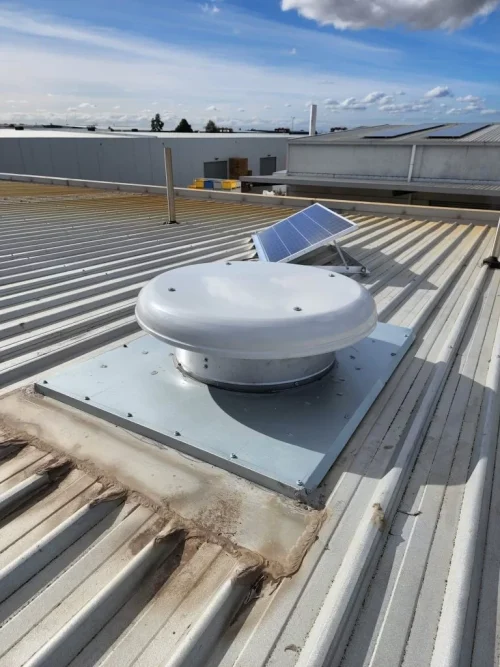
SW AU C 155 RAF
$2,995.00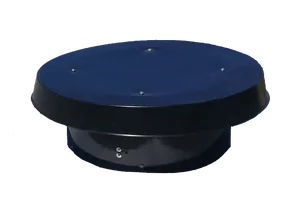
SW AU C 110 roof ventilation fan system Black
$2,450.00
SW AU C 110 RAF- Roof Mounted – 110W
$2,450.00
Vario Series Window and Wall Fans
$189.99 – $719.99
Solar Venti Professional Unit
$0.00Sources and citations
Every technical claim on this page comes from the manufacturer's own published material, extracted 2026-08-12. Airdry (Solair Pty Ltd) is an official Australian distributor for these brands. Where the manufacturer's figures conflict across their own pages, we've said so above rather than choosing one silently.
- https://www.solarwhiz.com.au/
- https://www.solarwhiz.com.au/home-ventilation/products/
- https://www.solarwhiz.com.au/news-information/residential-faqs/
- https://www.solarwhiz.com.au/sub-floor-ventilation-fans/
- https://www.solarwhiz.com.au/news-information/commercial-faqs/
No pricing is published by any manufacturer; all prices on this site are Airdry's own and include GST.